Sunday, February 19, 2017

'Lion' (2016 Film)

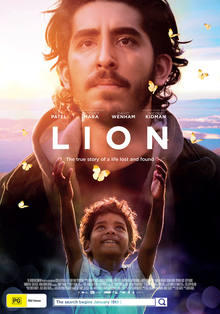
This film had me in tears.  I'm in a comfortable setting in USA watching a movie based on a book (A Long Way Home [Penguin, 2013]) about a 5 year old boy lost in India who is orphaned when his family can't be located and adopted by an Australian couple who raise him to adulthood and is haunted by memories of his loving mother and brother back in India.  His name is Saroo and his early life took place in poor circumstance, but was filled with love, thanks to his "Mum."  He eventually reunites with his first family with help from Google Earth.  This is a true story with a happy ending though filled with sadness.  So, so many children are homeless.  

This movie is provocative in that it will goad the well-off into thought about what might be done to solve the problem.  If a viewer takes action to help orphans, the movie has achieved its purpose.  It's a film with a message.  

This is a film which is beautiful in its structure and imagery.  Thanks to Saroo for documenting his story in writing and to the filmmakers for their careful and thoughtful art. In ending, I ask, dear God, why?

Lion (2016 film).png   

Saturday, November 5, 2016

Theory of Meaning


Theory of meaning is a part of the disciplines of philosophy and psychology.  'Meaning' or ultimate truth is what we seek in our attempt to understand what is.  Homo sapiens needs to know whatever there is to know.  We have sex and life and birth and death and eating, drinking, defecating and pain and pleasure and rain and dry spells; we also have minds and desires and emotions and thoughts and angst, a pang, a worry, fostered by our ignorance.  Like Socrates, we know that there is much we do not know.  So . . . science, we have the scientific enterprise, the attempt to know in certainty what is out there, in here (inside ourselves) and everywhere, even beyond the universe.  [What was before the big bang?]
Philosophy and psychology are partly unscientific disciplines in that they involve some guesswork and are content to leave hypothesis in place in their teaching as if it were fact.  Science doesn't countenance this, but tries to turn hypothesis into fact with experiment.  Nobody has ever discovered ego in the brain, yet it is an accepted psychological term.  So anyway what do you think?  Is there an ultimate truth behind the cosmos?  Is human life meaningful in the cosmic scale?


                                                                         Sunset


Addenda:  Search for meaning is also part of literary study as stories are told to entertain and to                   provoke thought or answer questions about why or how came something.  From olden                   myth to modern novel, storytelling has included the purpose of finding meaning, large                   and small.  Religious studies too, traverse this terrain.
                
                The question is why do we have this propensity to search for meaning, to look for                         something more?  Why aren't we content with the way things are?    
Humility

"Come unto me all you who labor and are heavy burdened and I will give you rest . . . for I am gentle and humble in heart .." (Mt 11.28f).  Humility is something good to have and to hold in one's life.  It is a virtue or value, an aspect of one's character or self which can be developed and worked on in making yourself a better or good person.  It is a quality which comes into play in relations with others.  I'm willing to put the other on an equal or superior level to myself as a matter of course.  I'm not special or better.  I'm no v.i.p.  My view of myself is that I'm here to help you. You and me, from God's viewpoint, are interchangeable.  Be humble, because in truth each of us is morally low.


Saturday, April 23, 2016

The Film 'In the Heart of the Sea' - Take Home Message


'In the Heart of the Sea,' a film by Ron Howard, is worth watching for the background material it supplies to that great novel, Moby Dick.  Many may not be aware that Moby-Dick was based upon the story of the whaleship Essex, sunk in 1820 by a mighty sperm whale.  Behind the film lies the book, In the Heart of the Sea:  The Tragedy of the Whaleship Essex by Nathaniel Philbrick, an historical account of that ship and its crew.


The Essex was struck repeatedly and purposely by the whale.  After the vessel's demise, the crew were forced into their three remaining boats and eight men survived the three month ordeal across the vast Pacific until they were rescued near the South American coast.  This ordeal, in which the men were reduced to cannibals, actually drawing lots to shoot each other to provide sustenance to the lucky ones, is the basis for understanding the film.  The film tells us something about ourselves, about man, writ large.  All I'll say is that we are not so great. so don't be fooled.                                                                                                                                                                                                                                                                                                                          

Thursday, March 17, 2016

Why Climb a Mountain?

Two men, Edmund Hillary of New Zealand and Tenzing Norgay of Nepal, reached the summit of Mount Everest on May 29, 1953, the first to achieve the feat of standing atop the highest point on Earth, some 29,000 feet up from sea level.  They made it safely back down the mountain, living to tell the tale.
 
An earlier explorer, George Mallory, who died upon the mountain in 1924, used to say he wanted to climb Everest "because it 's there."  If we understand Mallory's answer, we know something profound about humankind.
Mallory
       Human life is a test, a challenge.  We are challenged to survive in good form.  Some analogs for 'good form' would be 'nature' or 'soul.'  The individual human being is to preserve his soul through time.  That's it, that's the fundamental challenge to a person from birth to death. Be good, not bad. Become good.    

Saturday, January 16, 2016

Writing a Book

What does it mean to write a book?  I've just seen the movie, 'Pawn Sacrifice,' about Bobby Fischer and it reminds me of the place of knowledge and truth in human existence.  These things ought not be taken for granted and ought to be critically examined. Books and the process of writing one, I think are a way into the search for knowledge and truth.  What is knowledge?  What is truth?  Knowledge is the content of mind and it is the object of mind to get knowledge.  Truth is the outcome of the verification of knowledge.  Is there ultimate truth?  Of course there is!  It's God's knowledge.    

Friday, October 30, 2015

The Point of Prayer

  There comes a moment in life when a prayer rises up from your heart to your head and then up to God.  I experienced this today and decided to make a note of it.  The process is spontaneous, though I suppose one's personality and memory have their places in the background.  What I'm talking about is the transformation of an aesthetic experience into a religious act.  The primary experience is basically a feeling of bliss prompted by some external stimulus, music, a painting, which suddenly changes into a request to God.  We ask God for something we want.  This 'something' is what we're passionate about.
  The process, which is certainly an emotional process, is sudden, unexpected and quick.  It leaves one wondering.  Did God hear my prayer?  Where did that come from?  Why did that happen?  The feeling is tantamount to joy.  It quickly dissipates.  Where did it go?